

Home Decor and Accessories Market to Reach USD 1,142.78 Billion by 2035, Growing at a 3.24% CAGR
Home Decor and Accessories Market
Rising disposable income, e-commerce expansion, and sustainability trends are reshaping the global home decor and accessories industry through 2035.
As consumers spend more time curating their living spaces, home decor has evolved from a discretionary purchase into an everyday expression of identity, comfort, and personal values.”
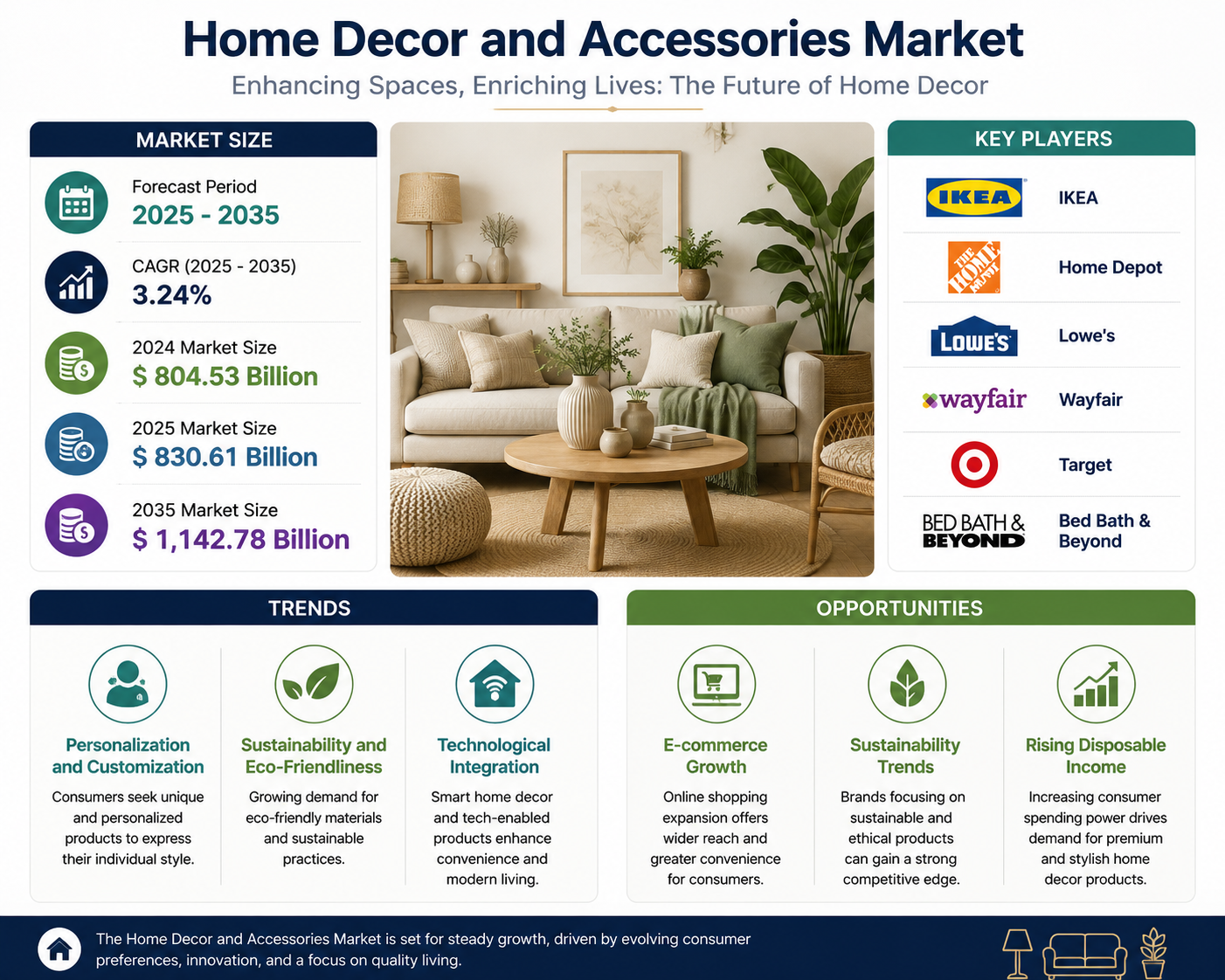
NEW YORK, NY, UNITED STATES, July 23, 2026 /EINPresswire.com/ -- The global Home Decor and Accessories Market is charting a steady and durable growth path, with its value expected to climb from USD 830.61 billion in 2025 to USD 1,142.78 billion by 2035, reflecting a compound annual growth rate (CAGR) of 3.24% across the forecast period. The market was valued at USD 804.53 billion in 2024, underscoring a consistent upward trajectory driven by evolving consumer lifestyles, the maturation of e-commerce channels, and a growing cultural emphasis on personalized, sustainable living environments.— Market Research Future (MRFR)
Once viewed largely as a discretionary, occasion-driven purchase category, home decor and accessories have steadily become part of consumers' ongoing lifestyle spending. From furniture and lighting to textiles, wall décor, and small accessories, today's homeowners and renters alike are treating their living spaces as an extension of personal identity — a shift accelerated by social media, remote and hybrid work arrangements, and rising urban homeownership and rental activity across both mature and emerging economies.
Market Overview: A Decade of Steady, Structural Growth
The home decor and accessories industry sits at the crossroads of interior design, retail innovation, and shifting consumer values. Unlike categories driven by short-lived fads, this market's projected 3.24% CAGR through 2035 points to durable, incremental expansion rather than a temporary post-pandemic bump in home spending. Years of elevated time spent at home, combined with a broader cultural embrace of self-expression through interior design, have embedded home decor purchasing into regular household budgets rather than treating it as an occasional indulgence.
This steady growth is also being reinforced by structural changes in how consumers shop. Digital retail infrastructure has matured to the point where large-ticket furniture and decor items — once purchases reserved for in-store visits — are now routinely researched, customized, and bought online. At the same time, retailers are investing in augmented reality visualization tools, faster fulfillment networks, and expanded product assortments that make it easier for consumers to discover and commit to new decor styles, further widening the addressable market.
Get Full PDF Sample Copy of Report: (Including Full TOC, List of Tables & Figures, Chart) @ https://www.marketresearchfuture.com/sample_request/33398
Market Segmentation: Where Growth Is Concentrated
The Home Decor and Accessories Market report from Market Research Future segments the industry across four principal dimensions, each revealing distinct pockets of opportunity.
By Product Type, the market spans Furniture, Textiles, Lighting, Wall Décor, and Accessories. Furniture remains the single largest category, anchored by its essential role in outfitting living spaces with items such as sofas, beds, and tables that combine function with style. Lighting, while a comparatively smaller slice of the overall market, is the fastest-growing product segment, propelled by rising consumer interest in ambiance, energy efficiency, and increasingly smart, connected fixtures that merge aesthetics with home-technology integration.
By Material, the market is categorized into Wood, Metal, Glass, Fabric, and Plastic. Wood continues to lead as the preferred material, valued for its durability, natural warmth, and timeless appeal across furniture, wall treatments, and flooring applications. Fabric, meanwhile, stands out as the fastest-growing material segment, as consumers increasingly gravitate toward textiles and upholstery that offer variety in texture, pattern, and color — key levers for personalizing a space without committing to structural changes.
By Style, the market is divided into Modern, Traditional, Contemporary, Rustic, and Minimalist aesthetics. Modern decor, characterized by clean lines and understated functionality, remains the dominant style choice for a broad cross-section of consumers. Rustic decor is the fastest-growing style category, gaining favor among homeowners drawn to reclaimed materials, earthy palettes, and a warmer, nature-connected sense of comfort — a preference closely tied to the broader sustainability movement reshaping consumer purchasing habits.
By Distribution Channel, the market serves Online Retail, Specialty Stores, Department Stores, and Home Improvement Stores. Online Retail is firmly the largest and most influential channel, giving consumers the ability to browse expansive product catalogs, compare pricing, and complete large purchases without leaving home. Specialty Stores, despite a smaller overall footprint, are the fastest-growing channel, benefiting from their ability to offer curated, niche selections and a more personalized shopping experience that mass-market retailers often cannot replicate.
By Geography, the market spans North America, Europe, Asia-Pacific, South America, and the Middle East & Africa, with North America and Asia-Pacific representing the market's largest and fastest-growing regional engines, respectively.
Key Trends Shaping the Market Through 2035
The Market Research Future report identifies several defining trends that will steer the trajectory of the home decor and accessories industry over the coming decade.
Personalization and Customization. Consumers are increasingly rejecting one-size-fits-all decor in favor of pieces and product combinations that reflect their individual tastes, routines, and living arrangements. This trend is visible across every segment of the market, from made-to-order furniture and modular shelving to customizable textiles and accent pieces, as brands respond to demand for decor that feels distinctly personal rather than mass-produced.
Sustainability and Eco-Friendliness. Environmental consciousness has moved from a niche preference to a mainstream purchasing criterion. Shoppers are actively seeking out products made from reclaimed wood, organic textiles, recycled metals, and responsibly sourced materials, and are showing a willingness to pay a premium for items marketed as eco-friendly or ethically produced. Brands that can credibly demonstrate sustainable sourcing and production practices are increasingly using that positioning as a competitive differentiator.
Technological Integration. Smart home technology is steadily working its way into mainstream decor, from app-controlled lighting and climate-responsive fixtures to furniture embedded with wireless charging and connectivity features. This integration of convenience and design is reshaping consumer expectations, with technology increasingly viewed not as an add-on but as a baseline feature of contemporary home décor.
Beyond these core trends, the influence of social media platforms such as Instagram and Pinterest continues to shape purchasing decisions at scale, as curated interiors shared online create aspirational benchmarks that drive discovery and demand for specific styles and products. Urbanization is compounding this effect, as smaller urban living spaces push consumers toward multi-functional furniture and space-optimizing decor solutions that blend practicality with style.
Competitive Landscape: Established Retail Leaders Drive Innovation
The Home Decor and Accessories Market remains shaped by a mix of globally recognized retail giants and specialized players, each pursuing distinct strategies to capture share in a moderately fragmented competitive landscape. Key companies featured in the report include IKEA, Home Depot, Lowe's, Wayfair, Target, and Bed Bath & Beyond, alongside other notable participants such as Williams-Sonoma, Crate and Barrel, and Ashley Furniture.
These companies are pursuing a range of strategic initiatives to strengthen their market positions. IKEA continues to emphasize affordability paired with sustainability commitments, including the expansion of eco-friendly product lines using recycled and responsibly sourced materials. Home Depot is investing heavily in its omnichannel capabilities, including augmented reality tools that let shoppers visualize products inside their own homes before purchasing. Wayfair, leveraging its extensive online marketplace model, has been expanding partnerships with local and independent artisans to offer exclusive, handcrafted decor items that differentiate its catalog from mass-produced alternatives.
Beyond these established leaders, the competitive landscape is being reshaped by growing localization of manufacturing and supply chains, as companies work to respond more quickly to shifting regional demand and reduce exposure to global logistics disruptions. The market's moderate fragmentation also leaves meaningful room for niche and specialty players to carve out loyal customer bases, even as larger retailers use scale advantages to compete on price, delivery speed, and product breadth. Looking ahead, competitive differentiation is expected to shift increasingly from price-based competition toward innovation, digital experience, supply chain reliability, and demonstrable sustainability credentials.
Regional Dynamics
North America remains the largest regional market for home decor and accessories, accounting for approximately 40% of global market share. Growth in the region is underpinned by rising disposable incomes, an enduring cultural emphasis on home improvement, and high rates of online shopping adoption. The United States represents the region's largest single market, with Canada contributing a meaningful secondary share, and competition remains concentrated among major players such as IKEA, Home Depot, and Wayfair, all of which combine extensive physical footprints with strong digital platforms.
Europe represents the second-largest regional market, holding roughly 30% of global share, with growth driven by a strong regional emphasis on sustainability, rising interest in DIY home projects, and continued innovation in design. Germany and France lead the European market, with Germany's share bolstered by strong consumer demand for eco-friendly products and smart home technology integration. The European competitive landscape blends established multinational retailers with local artisans and craftspeople, reflecting the region's balance of modern design sensibility and traditional craftsmanship.
Asia-Pacific, holding an estimated 25% of the global market, is the fastest-growing region over the forecast period, propelled by rapid urbanization, expanding middle-class populations, and rising disposable incomes across markets such as China and India. China alone represents a substantial share of the global market, and the region as a whole is experiencing a pronounced shift toward online retail channels as e-commerce infrastructure continues to expand and mature.
The Middle East & Africa region, while currently the smallest contributor at roughly 5% of global share, is showing meaningful long-term growth potential. Rising urbanization and disposable incomes, combined with growing interest in home aesthetics, are driving demand in markets such as the United Arab Emirates and South Africa, with the UAE in particular showing strong appetite for luxury and premium home decor products.
Market Drivers and Opportunities
Several structural factors continue to underpin the market's sustained growth outlook. E-commerce growth remains one of the most influential forces reshaping the industry, as digital platforms allow brands to reach broader audiences, offer more expansive product assortments, and compete on convenience in ways traditional brick-and-mortar retail cannot easily match. Online sales in the home decor category have consistently outpaced traditional retail channel growth, reinforcing the importance of digital presence and marketing sophistication for brands seeking to expand share.
Sustainability trends represent a second major growth driver, as environmentally conscious purchasing behavior continues to gain ground across nearly every consumer demographic. Demand for sustainably sourced materials — including reclaimed wood and organic textiles — is prompting manufacturers to rethink sourcing strategies and product development, while consumers' willingness to pay a premium for verified sustainable products gives eco-focused brands a meaningful competitive advantage.
Rising disposable income, particularly across emerging economies, continues to expand the pool of consumers able to invest in home improvement and decorative purchases. As a growing global middle class seeks to elevate living standards, spending on home decor is increasingly correlated with broader household income growth, suggesting continued market expansion as economic conditions improve across developing regions.
Additional opportunities are emerging around the expansion of eco-friendly product lines, the integration of smart home technology directly into decor products for enhanced functionality, and the development of AI-driven personalized design tools that can guide consumers toward decor choices tailored to their specific space and style preferences.
Market Restraints and Challenges
Despite a positive long-term outlook, the industry faces several headwinds. Intensifying competition between large-scale retailers and a growing base of niche, direct-to-consumer decor brands is placing pressure on pricing and margins across the category. Supply chain volatility — particularly for materials such as wood and other natural inputs subject to sourcing and climate-related disruptions — continues to pose risks to production consistency and cost stability.
Consumer discretionary spending on home decor also remains sensitive to broader macroeconomic conditions, meaning periods of economic uncertainty or reduced consumer confidence can temper big-ticket furniture and decor purchases even as smaller accessory purchases persist. Additionally, as sustainability claims become a more prominent purchasing factor, brands face increasing scrutiny over the authenticity of their environmental credentials, raising the bar for credible, verifiable sourcing and production practices.
Outlook
With the market projected to expand from USD 830.61 billion in 2025 to USD 1,142.78 billion by 2035, the home decor and accessories industry is positioned for a decade of steady, consumer-driven growth. Companies that successfully combine digital retail excellence, credible sustainability practices, and product innovation — particularly around personalization and smart-home integration — are well positioned to capture disproportionate share of this expanding market. As homes continue to serve as both functional living spaces and personal expressions of identity, home decor and accessories are set to remain a resilient and evolving pillar of global consumer spending through 2035.
Discover Related Research Reports By Market Research Future:
Decorative Illuminated Mirror Market
https://www.marketresearchfuture.com/reports/decorative-illuminated-mirror-market-41459
Glass Bottles Jars Decoration Market
https://www.marketresearchfuture.com/reports/glass-bottles-jars-decoration-market-11054
Textile Home Decor Market
https://www.marketresearchfuture.com/reports/textile-home-decor-market-24239
Sagar Kadam
Market Research Future
+ +1 628-258-0071
email us here
Legal Disclaimer:
EIN Presswire provides this news content "as is" without warranty of any kind. We do not accept any responsibility or liability for the accuracy, content, images, videos, licenses, completeness, legality, or reliability of the information contained in this article. If you have any complaints or copyright issues related to this article, kindly contact the author above.
